The method everyone remembers from the hangar is the liquid that makes cracks glow in the dark. It is also the one whose physics nobody explains. It is one formula.
The pull: capillary pressure
A liquid that wets a surface wants to spread over it. In a narrow gap the surface is close on both sides, the liquid's surface curves, and that curve pulls the liquid in. Treating a crack as a slit of width w between two flat walls, the pressure pulling the liquid in is:
P = 2γ · cos θ / w
γ is the liquid's surface tension and θ its contact angle on the metal: 0° for a liquid that spreads flat, 90° for one that sits there as a bead. Width is on the bottom, so the narrower the crack, the harder it pulls.
To get a feel for the size, take water, γ = 0.072 N/m, and assume it wets perfectly, θ = 0:
| Crack width w | Capillary pressure P | Height it could lift water, P / ρg |
|---|---|---|
| 100 µm | 1.44 kPa | 0.15 m |
| 10 µm | 14.4 kPa | 1.47 m |
| 1 µm | 144 kPa | 14.7 m |
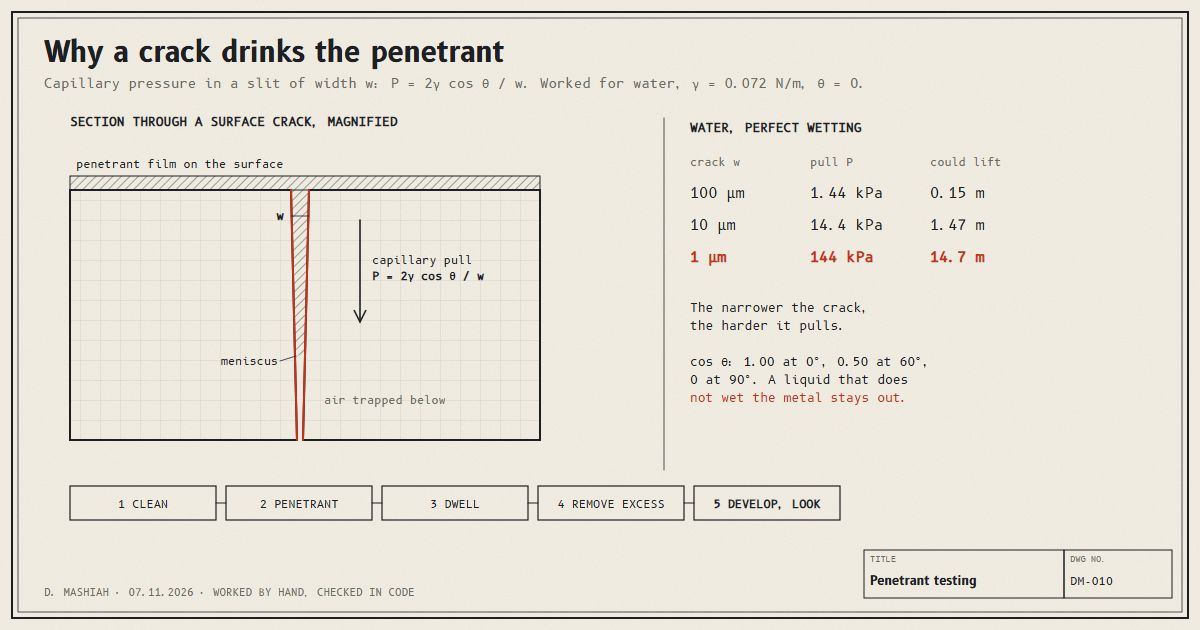
The 1 µm crack pulls at 1.42 times atmospheric pressure. Gravity is irrelevant at this scale, so the method works on the underside of a wing as well as on top of it.
Water is the worked example because its numbers are well known, not because it is used. It is a poor penetrant: what decides the pull is γ · cos θ, and water does not wet metal well. Real penetrants are oils chosen to spread over metal, with a contact angle close to zero, so cos θ stays close to one.
The contact angle is the term that can kill the whole thing. cos θ is 1.00 at 0°, 0.87 at 30°, 0.50 at 60° and zero at 90°. A liquid that does not wet the metal stays out of the crack at any width. That is why the first step is cleaning.
The five steps
- Clean. Oil, grease, paint or water in the crack either raise the contact angle or fill the gap the penetrant needs. A crack already full of something else has no room left.
- Apply the penetrant, by dipping, spraying or brushing.
- Dwell. The pressure is large, but the liquid still has to flow down a gap a few micrometres wide, and a thicker liquid flows more slowly. The penetrant is left on long enough to fill the cracks.
- Remove the excess from the surface without pulling it out of the cracks. Too little cleaning leaves a background that hides everything. Too much washes the cracks out.
- Develop and look. A thin white developer is applied. It is a fine powder, and its pores pull the penetrant back out of the crack by the same capillary action, spreading it into a mark much wider than the crack itself.
The developer is what makes a crack you cannot see into a line you can. The crack might be a micrometre wide. The mark it leaves in the developer is wide enough to see by eye.
Visible dye or fluorescent
Visible dye penetrant is usually red, read against the white developer in ordinary light. It needs no lamp and no dark room, so it goes anywhere.
Fluorescent penetrant carries a dye that glows under ultraviolet light. The part is inspected in a darkened booth, and a crack shows as a bright line on a dark surface. The eye is much better at finding a small light in the dark than a small red line on white, which is why fluorescent penetrant is the more sensitive of the two and the one we used on aircraft parts in the hangar.
What it cannot see
It only finds flaws open to the surface. The liquid has to get in. A void inside the part, however large, gives nothing. For that there is ultrasound or X-ray.
It does not work on porous materials. The whole surface is a network of gaps, so it all holds penetrant, and a crack cannot stand out from the background.
And it can be defeated by the preparation. Sanding, grinding or blasting a soft metal such as aluminium can smear a thin layer of metal over the mouth of a crack and close it. The crack is still there, but the liquid cannot get in, and the part looks clean. On steel, magnetic particle inspection does not have this weakness. A crack open to the surface is also exactly what eddy current testing finds without any liquid, which is why the two are often used on the same kind of part.
References
- Federal Aviation Administration. Advisory Circular 43.13-1B, Acceptable Methods, Techniques, and Practices: Aircraft Inspection and Repair. Chapter 5, Nondestructive Inspection.
- Federal Aviation Administration. Aviation Maintenance Technician Handbook: General (FAA-H-8083-30). Chapter on inspection concepts and techniques.