Lift, propeller thrust and the power of an engine without a turbocharger all depend on air density, the mass of air in each cubic metre. Density falls with height and with heat. Density altitude folds both into one number: the height in the standard atmosphere where the air would be this thin.
The airspeed indicator feels density too, which is the subject of the pitot tube note. The second half of this note picks up from there, with true airspeed.
From pressure and temperature to density
Set the altimeter to 1013.25 hPa and it reads pressure altitude, the height in the standard atmosphere with today’s pressure. In the International Standard Atmosphere, up to 11 km, temperature falls 6.5 °C per kilometre from 15 °C at sea level, and pressure follows from that:
p = 101325 × (1 − 0.0065 h / 288.15)^5.256, with h in metres
Density then comes from the gas law with the actual outside air temperature, not the standard one: ρ = p / (R T), with R = 287.05 J/(kg·K) and T in kelvin. Density altitude is the standard-atmosphere height that has that same ρ.
A worked case
Pressure altitude 5000 ft, outside air 30 °C. The standard temperature at 5000 ft is 5.1 °C, so the day is about 25 °C hot. The density works out at 79.1 percent of standard sea-level density, which the standard atmosphere reaches at 7800 ft.
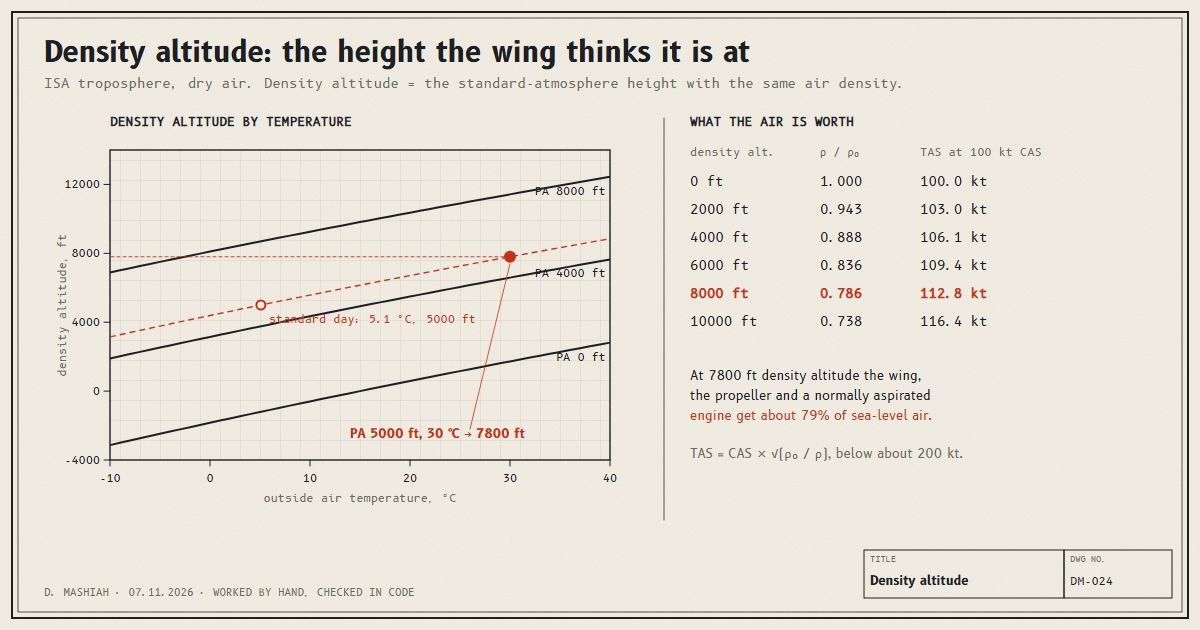
The common rule of thumb adds about 120 ft for every degree above standard: 5000 + 120 × 24.9 = 7990 ft. That is close, and slightly high. The table below is computed exactly.
Density altitude table
Density altitude in feet, rounded to 10 ft, by pressure altitude and outside air temperature, for dry air. Humidity lowers density a little further, so on a humid day the true figure is somewhat higher.
| Pressure altitude, ft | ISA °C | -10 °C | 0 °C | 10 °C | 20 °C | 30 °C | 40 °C |
|---|---|---|---|---|---|---|---|
| 0 | 15.0 | -3130 | -1840 | -600 | 590 | 1720 | 2820 |
| 1000 | 13.0 | -1870 | -590 | 640 | 1820 | 2940 | 4030 |
| 2000 | 11.0 | -620 | 660 | 1880 | 3040 | 4160 | 5230 |
| 3000 | 9.1 | 640 | 1900 | 3110 | 4270 | 5380 | 6440 |
| 4000 | 7.1 | 1900 | 3150 | 4340 | 5490 | 6590 | 7640 |
| 5000 | 5.1 | 3150 | 4390 | 5580 | 6710 | 7800 | 8850 |
| 6000 | 3.1 | 4400 | 5630 | 6800 | 7930 | 9010 | 10050 |
| 7000 | 1.1 | 5650 | 6870 | 8030 | 9150 | 10220 | 11240 |
| 8000 | -0.8 | 6890 | 8100 | 9260 | 10360 | 11420 | 12440 |
| 9000 | -2.8 | 8140 | 9330 | 10480 | 11570 | 12630 | 13630 |
| 10000 | -4.8 | 9380 | 10560 | 11700 | 12790 | 13830 | 14830 |
True airspeed
The airspeed indicator measures dynamic pressure, ½ ρ v², and is calibrated for sea-level density. In thinner air the same reading needs a higher true speed through the air. Below about 200 kt, where compressibility is small:
TAS = CAS × √(ρ₀ / ρ)
In the worked case, 100 kt calibrated airspeed is 112.4 kt true. The wing sees the same dynamic pressure as at 100 kt at sea level, so it stalls at the same indicated speed, but the aeroplane covers the ground faster, including on the takeoff run and the landing roll.
True airspeed in knots by density altitude and calibrated airspeed:
| Density altitude, ft | ρ / ρ₀ | 60 kt CAS | 80 kt CAS | 100 kt CAS | 120 kt CAS | 140 kt CAS |
|---|---|---|---|---|---|---|
| 0 | 1.000 | 60 | 80 | 100 | 120 | 140 |
| 2000 | 0.943 | 62 | 82 | 103 | 124 | 144 |
| 4000 | 0.888 | 64 | 85 | 106 | 127 | 149 |
| 6000 | 0.836 | 66 | 88 | 109 | 131 | 153 |
| 8000 | 0.786 | 68 | 90 | 113 | 135 | 158 |
| 10000 | 0.738 | 70 | 93 | 116 | 140 | 163 |
| 12000 | 0.693 | 72 | 96 | 120 | 144 | 168 |
The usual rule of thumb, 2 percent per 1000 ft, gives 116 kt at 8000 ft for 100 kt CAS. The exact figure is 112.8, so the rule runs a little high.
What the numbers do and do not say
At 7800 ft density altitude there is about 79 percent of sea-level air in every cubic metre. A normally aspirated engine breathes less mass, so it makes less power. The propeller has less air to push, and the wing needs a higher true speed for the same lift. All three point the same way: a longer takeoff and a slower climb.
How much longer is a property of each aeroplane, and the only numbers to use are the ones in its flight manual. The tables here give the density altitude to look those up with. They are a worked model of the standard atmosphere, not a substitute for the manual.
References
- Federal Aviation Administration. Pilot's Handbook of Aeronautical Knowledge (FAA-H-8083-25). Chapter on aircraft performance.