I was about nineteen, at an Israeli Air Force technical school, when I watched a screwdriver lock up an aircraft engine.
Nobody in the story did anything they did not know how to do. That is the part worth writing down.
What the check is for
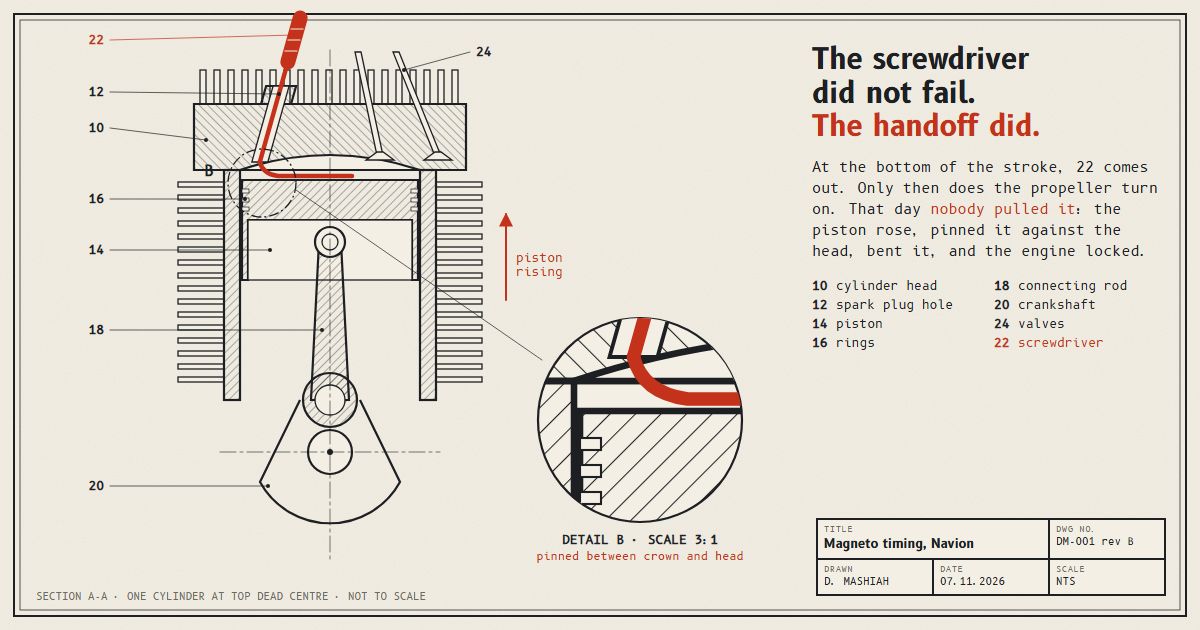
A piston engine needs its spark at the right moment in the piston's travel. The spark comes from the magneto, and checking the magneto's timing means knowing exactly where the piston is when the spark plug fires. If it fires at the wrong moment, you adjust the magneto.
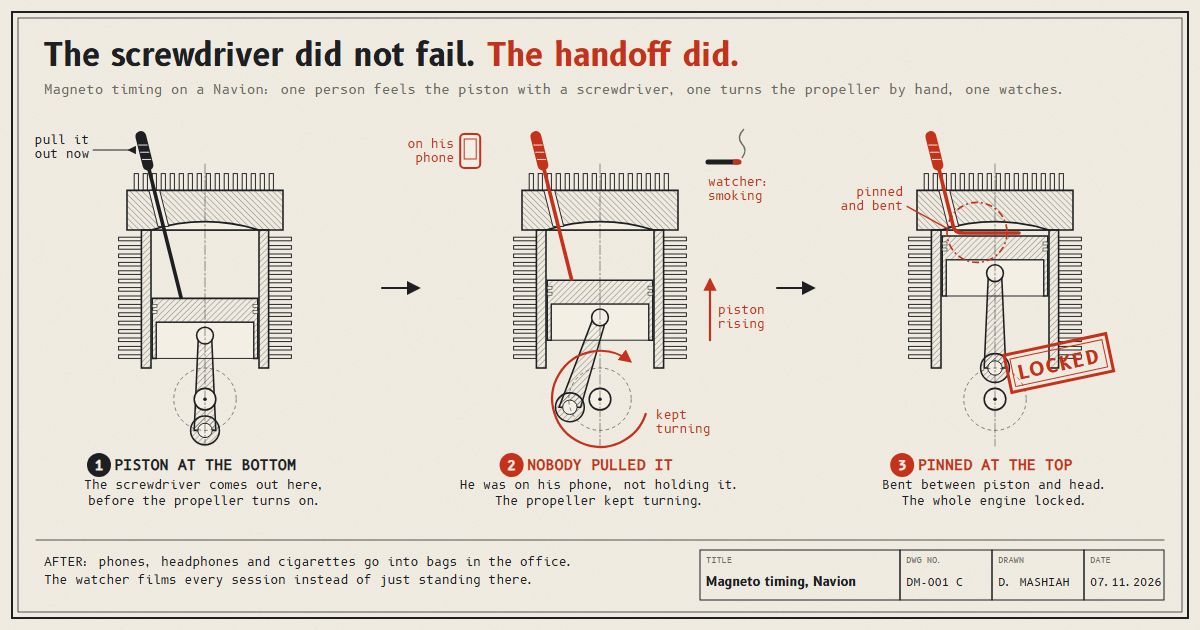
We were doing this on the engine of a Navion, an old single-engine aircraft, the way we were taught. The spark plug comes out. One person puts a screwdriver into the spark plug hole until it rests on the piston. A second person turns the propeller by hand, slowly, which turns the whole engine. A third watches the other two and makes sure they stay in sync.
As the propeller turns, the piston goes down and the screwdriver follows it. When the person holding it feels the bottom, the screwdriver comes out. Then the propeller turns slowly up again, and you watch for the spark, to see that it fires when it should.
The order matters. A screwdriver left in the hole has nowhere to go when the piston comes back up.
That day
The person on the screwdriver was on his phone. He was not even holding it. The person who was supposed to be watching was smoking, next to an engine that always has some oil and fuel residue in it, however well you clean it.
So nobody pulled the screwdriver. The propeller kept turning, the piston came up, pinned the screwdriver against the cylinder and bent it, and the engine locked. One piston that cannot move stops all of them, because they all sit on the same crankshaft.
Push harder
I had come over because I saw the cigarette. By then the idea was to push the propeller harder and get it past whatever was stuck.
I stopped them. Forcing a locked engine is how a bent screwdriver becomes bent engine parts. The propeller would not turn back either, and after what had just happened, nobody was going to force it in that direction. The screwdriver was bent where the piston had caught it and would not come out of the hole.
So we took that cylinder off, took the parts out, freed it and built it up again, then redid the timing so it was back in step with the rest of the engine. The piston was fine. I am still not sure it was the quickest way. It was the way that could not make it worse.
What changed
The procedure did not change. It had been right all along. The room changed.
- Phones, headphones and cigarettes go into bags in the office before anyone touches the engine.
- The person watching films every session, instead of just standing there.
The second rule is the better one. Standing there is easy to do while thinking about something else. Filming means the watcher has to point at the screwdriver and the propeller the whole time, and it leaves a record of who did what.
The handoff
The screwdriver did not fail. The engine did not fail. Each of the three knew his part. What failed was the moment where one person's part ends and the next one's begins: the screwdriver coming out before the propeller keeps going. Nothing in the job forced that moment to happen. It relied on attention, and the attention was somewhere else.
Most failures I have seen since, in hardware and in code, look like this one. The parts work. The handoff between them is where it breaks, and it breaks quietly, because each side is doing exactly what it was told. The fix is rarely a better part. It is making the handoff impossible to skip.
More from the same hangar, including why you see sparks when you turn a propeller, is in a note on taking engines apart at sixteen.